
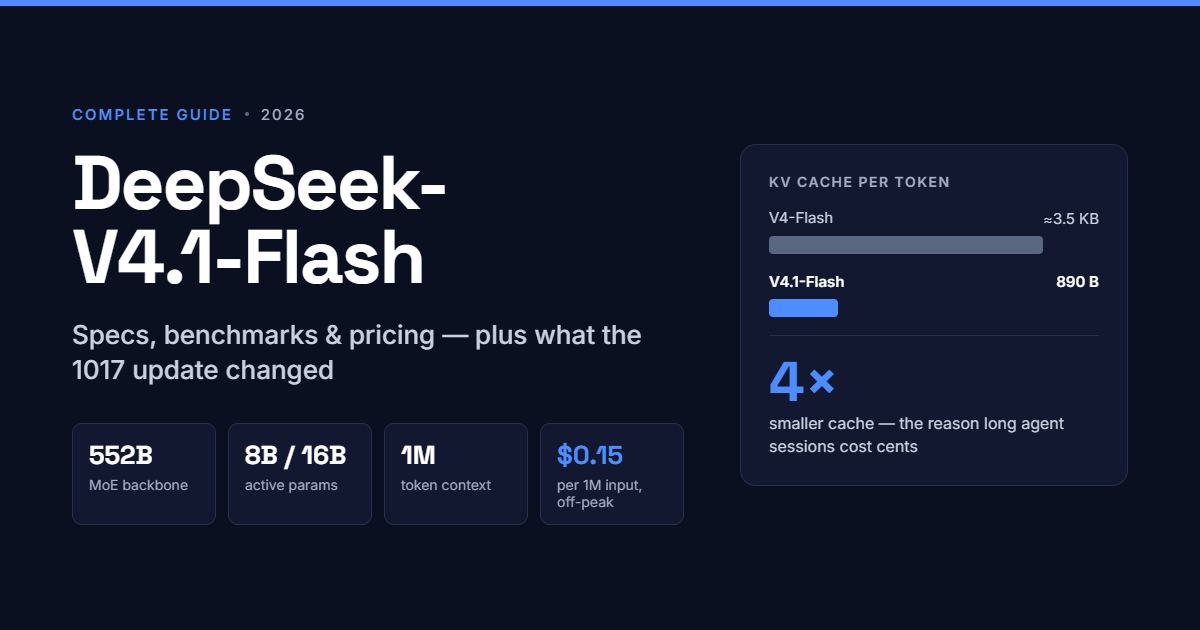
DeepSeek-V4.1-Flash is the cheapest model DeepSeek has ever shipped that genuinely competes with frontier systems on agentic coding and with the October 17 update (DeepSeek-V4.1-Flash-1017), it now beats Claude Opus 5 and GPT-5.6 Sol on several agent benchmarks while costing $0.15–$0.30 per million input tokens.
That sentence sounds like marketing, so this guide does what most write-ups skip. We went through the official announcement, both Hugging Face model cards, the arXiv technical report, DeepSeek’s API changelog, and independent data from Artificial Analysis, Vals AI, OpenRouter, OpenCode, Ollama and Venice. Then we put it all in one place, including the parts DeepSeek doesn’t put in bold.
TL;DR — DeepSeek V4.1 Flash in 60 seconds
- What it is: a 552B-parameter multimodal Mixture-of-Experts model (text + image in, text out) with a 1M-token context window.
- The trick: a new Causal Encoder–Decoder (CED) design that activates only 8B parameters when reading input and 16B when writing output.
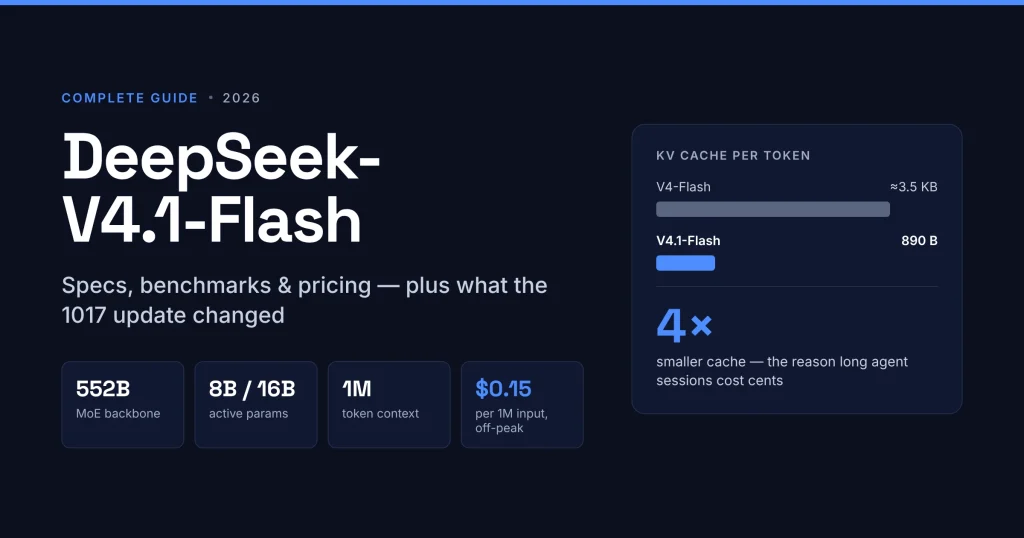
- Why it’s cheap: its KV cache is about 1/4 the size of V4-Flash in GPU memory and about 1/8 on SSD, which slashes the cost of long agent sessions.
- Releases: V4.1-Flash on September 10, 2026; the improved DeepSeek-V4.1-Flash-1017 on October 17, 2026.
- Price (DeepSeek API): $0.30 input / $1.20 output per 1M tokens at peak, half that off-peak, and cache hits from $0.003.
- License: MIT, with open weights on Hugging Face.
- Best for: coding agents, terminal and computer-use agents, long-document and multimodal analysis on a budget.
- Weak spots: very long, multi-hour terminal tasks and raw knowledge-heavy reasoning (HLE) still favour the top closed models.
What is DeepSeek-V4.1-Flash?
DeepSeek-V4.1-Flash is the first and smallest model in DeepSeek’s new V4.1 architecture family, built to make long-running AI agents cheap. DeepSeek describes it as a multimodal MoE with 552B backbone parameters that reads images and text natively and supports contexts up to one million tokens (Hugging Face model card).
The “Flash” name is a little misleading. In the V4 generation, Flash meant the small, cheaper sibling of V4-Pro. V4.1-Flash breaks that pattern: DeepSeek says it outperforms V4-Pro on performance, cost, speed and total runtime, so it is phasing V4-Pro out entirely (DeepSeek announcement).
In practice, that makes V4.1-Flash DeepSeek’s main production model today. When you call deepseek-flash on the DeepSeek API, this is what answers.
Three things set it apart from earlier DeepSeek models:
- Native vision. Images and text were trained together from the start of pre-training, unlike the bolted-on V4-Flash-Vision-Exp.
- Asymmetric compute. It uses fewer active parameters to read your prompt than to write its answer.
- A tiny KV cache. Long contexts and cached agent histories cost far less memory and money.
DeepSeek V4.1 Flash release timeline
V4.1-Flash replaced three DeepSeek models in about five weeks. Here is how the lineage fits together, newest first (DeepSeek API news).
| Date | Release | What happened |
|---|---|---|
| Oct 31, 2026 | Search & Fetch billing | Server-side search calls from agent tools start billing at $0.75 per 1,000 calls |
| Oct 17, 2026 | DeepSeek-V4.1-Flash-1017 | Minor update: higher scores, faster task completion, shorter outputs; now serves deepseek-flash |
| Sep 17, 2026 | Technical report on arXiv | arXiv:2609.19969, “Pushing the Limits of KV Cache Compression” |
| Sep 14, 2026 | V4-Pro routed to V4.1-Flash | All deepseek-v4-pro requests served by V4.1-Flash at Flash prices, until V4.1-Pro ships |
| Sep 10, 2026 | DeepSeek-V4.1-Flash | Launch, open weights (MIT), new lower prices; V4-Flash and V4-Flash-Vision-Exp retired |
| Aug 21, 2026 | V4-Flash-Vision-Exp | Experimental vision add-on for V4-Flash |
| Aug 13, 2026 | V4-Pro GA | 1.6T-parameter flagship goes generally available |
| Apr 24, 2026 | DeepSeek-V4 Preview | V4-Flash and V4-Pro debut with 1M context |
One small detail for anyone tracking model IDs: before the public launch, a short limited beta ran under a temporary model name that expired on September 10.
DeepSeek-V4.1-Flash specs at a glance
The headline numbers: 552B backbone, 8B/16B active, 1M context, 45T training tokens, MIT license. Sources: the model card, technical report and OpenCode data.
| Spec | DeepSeek-V4.1-Flash |
|---|---|
| Developer | DeepSeek-AI |
| Model type | Multimodal Mixture-of-Experts (image + text in, text out) |
| Backbone parameters | 552B |
| Active parameters | 8B per token in prefill (reading), 16B in decode (writing) |
| Checkpoint size on Hugging Face | 763B (includes extras such as the 196B Engram memory module) |
| Layers | 40 (20-layer causal encoder + 20-layer decoder) |
| Experts | 1 shared + 384 routed per MoE layer, 6 routed active per token |
| Context window | 1,000,000 tokens |
| Max output | Up to 384K on DeepSeek’s API; 128K on some hosts like Venice |
| Global KV cache | 890 bytes per token (about 1/4 of V4-Flash) |
| Pre-training data | 45T multimodal tokens |
| Reasoning control | Continuous effort setting from 1 to 100 |
| Weights precision | FP8 (with BF16/F32 parts) |
| License | MIT (commercial use allowed) |
| API model name | deepseek-flash |
| Release | September 10, 2026; 1017 update October 17, 2026 |
Why two parameter counts? The 552B figure is the language backbone DeepSeek uses in its comparisons. Hugging Face counts every tensor in the checkpoint, including the sparsely accessed Engram memory and the vision encoder.
The architecture, explained without the jargon
Everything new in V4.1-Flash attacks one problem: AI agents read far more than they write, and reading is where the bills pile up. The technical report says prefill compute and oversized KV caches are now the main barrier to cheaper deployment (arXiv).
A coding agent might re-read a 200K-token repository on every step but only write a few hundred tokens of code. OpenCode’s data backs this up: 97% of V4.1-Flash input tokens on its platform are cache hits (OpenCode).
1. Causal Encoder–Decoder (CED): read light, write heavy
Most modern LLMs are decoder-only: every layer does the same work whether it’s reading your prompt or generating the answer. V4.1-Flash splits its 40 layers into a 20-layer causal encoder and a 20-layer decoder.
The decoder doesn’t build its own long-term memory layer by layer. Instead, it borrows a projection of the encoder’s final hidden states. The result is that only 8B parameters fire per token while reading and 16B while writing — exactly the asymmetry agent workloads need.
2. Compressed Sparse Attention 2 (CSA2): stop recomputing the same thing
CSA2 gives every attention layer one of three fixed jobs: Full, Reindex or Reuse. Layers can share the main KV cache and reuse the sparse-attention choices made by earlier layers instead of recomputing them.
In the decoder, a Hierarchical Sparse Indexer lets deeper layers search only a shortlist chosen by the first full layer. That keeps attention cost bounded even when the context grows toward a million tokens.
3. FP4 KV cache: a quarter of the memory
The main KV cache is stored in 4-bit floating point (E2M1, with one E4M3 scale per 16 channels). Combined with CSA2, the global cache drops to 890 bytes per token. DeepSeek says that is roughly 4x smaller than V4-Flash and about 437x smaller than DeepSeek-V1 (model card).
4. SWA Bounded Replay: less to keep on disk
Instead of saving sliding-window attention states to SSD, the model rebuilds them by replaying only the latest window of tokens. Persistent cache storage falls to about 1/8 of V4-Flash. This matters for providers, and indirectly for you, because cache-hit pricing is where agent costs live.
5. The supporting cast
- Single-Pass mHC: a revised way of mixing the residual stream, with a faster kernel.
- Engram conditional memory: 196B parameters looked up sparsely by token, a cheap form of stored knowledge.
- DSpark speculative decoding: drafts several tokens at once and verifies them by confidence, for faster output.
- DeepSeek-ViT: a vision encoder trained from scratch, feeding image embeddings in from the first day of pre-training.
Post-training uses the standard SFT, then RL, then on-policy distillation recipe. DeepSeek says all the real changes were in the data: large-scale, automatically generated agent tasks and environments.
DeepSeek V4.1 Flash benchmarks: where it wins and where it doesn’t
On agentic coding and tool use, the original V4.1-Flash tops every model in DeepSeek’s comparison, including Claude Opus 5.0 and GPT-5.6 Sol. On hard knowledge reasoning and the newest long terminal tasks, it still trails. All figures below are DeepSeek’s own, at maximum reasoning effort (model card).
| Benchmark | Opus 5.0 | GPT-5.6 Sol | Kimi K3 | GLM-5.3 | DS V4-Pro | DS V4-Flash | DS V4.1-Flash |
|---|---|---|---|---|---|---|---|
| GPQA Diamond | 93.4 | 94.1 | 92.9 | 88.1 | 92.4 | 89.9 | 90.9 |
| HLE (no tools) | 56.3 | 44.5 | 43.5 | 42.0 | 42.7 | 37.8 | 36.8 |
| HLE with tools | 63.6 | — | 59.8 | 62.5 | 60.0 | 51.5 | 63.9 |
| Codeforces rating | — | — | — | — | 3348 | 3289 | 3471 |
| MathArena Apex | — | — | 65.6 | — | 65.3 | 58.6 | 65.6 |
| Terminal-Bench 2.1 | 89.1 | 88.8 | 88.3 | 88.2 | 87.9 | 82.7 | 90.6 |
| Terminal-Bench 4.0 | 51.8 | 39.9 | 12.6 | 37.9 | 12.4 | 7.0 | 31.2 |
| DeepSWE v1.1 | 74.0 | 73.0 | 67.5 | 66.9 | 62.7 | 54.4 | 74.2 |
| NL2Repo-Bench | 75.3 | 56.8 | 58.0 | 58.0 | 61.5 | 54.2 | 64.0 |
| CyberGym | — | 84.5 | 80.0 | 84.5 | 83.3 | 76.7 | 88.1 |
| AutomationBench | 50.3 | 45.8 | 46.7 | 48.8 | 43.2 | 37.7 | 54.8 |
| Agent’s Last Exam | 28.6 | 26.7 | 27.6 | 28.5 | 25.7 | 25.2 | 31.8 |
| BabyVision (tools) | 94.1 | 88.9 | 85.7 | — | — | — | 89.6 |
What the table actually says:
- Agentic coding is the headline. 74.2 on DeepSWE v1.1 edges out Opus 5.0, and 90.6 on Terminal-Bench 2.1 is the best in the table.
- The jump over V4-Flash is huge. DeepSWE rose almost 20 points and Terminal-Bench 4.0 more than quadrupled, from 7.0 to 31.2.
- Long-horizon terminal work is the gap. On Terminal-Bench 3.0 and 4.0, Opus 5.0 is still well ahead.
- Raw knowledge is not its strength. HLE without tools lands below even V4-Pro, but add tools and it jumps to the top.
The harness matters more than you think
DeepSeek also tested V4.1-Flash inside eight different agent frameworks. On DeepSWE v1.1, scores ranged from 65.5 in OpenCode to 74.2 in mini-SWE, a nine-point spread from the harness alone. If you are benchmarking it yourself, test in the tool you will actually use.
Base model results
The pre-trained base model is close to V4-Pro-Base despite using a fraction of the active compute. It actually beats V4-Pro-Base on MMLU-Pro (74.1), HumanEval (79.4), BigCodeBench (60.6) and GSM8K (93.0), while trailing on long-context and factual recall tests like SimpleQA.
DeepSeek-V4.1-Flash-1017: what the October update changed
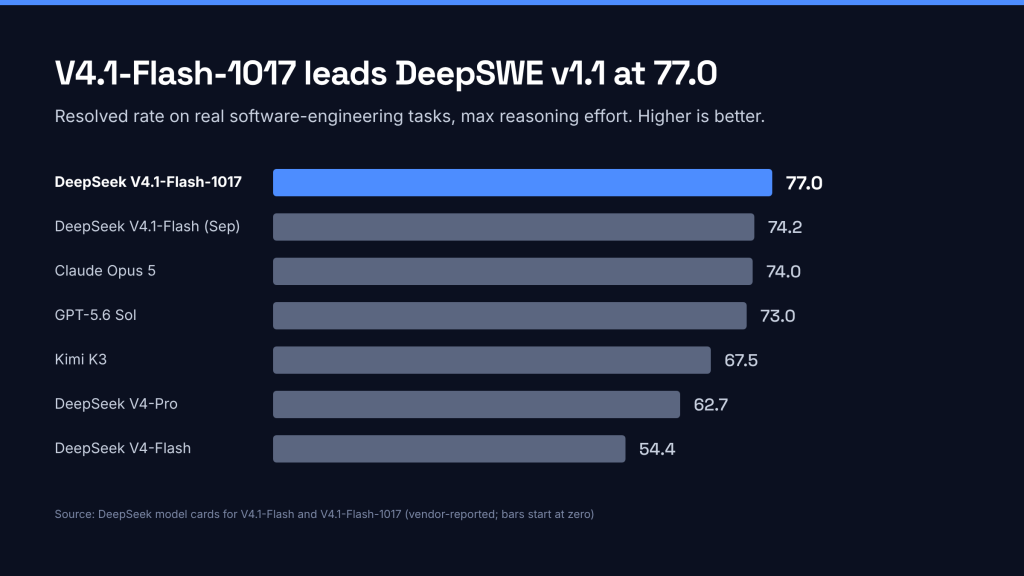
DeepSeek-V4.1-Flash-1017 is a same-architecture update that scores higher on every benchmark DeepSeek published while finishing tasks faster and with shorter outputs. DeepSeek calls it a Pareto improvement: better results and lower cost at the same time (DeepSeek API news).
It has been the model behind deepseek-flash on DeepSeek’s website, app and API since October 17, 2026. Weights are on Hugging Face and ModelScope under the same MIT license.
| Benchmark | V4.1-Flash (Sep) | V4.1-Flash-1017 | Change | Opus 5 | GPT-5.6 Sol |
|---|---|---|---|---|---|
| HLE, no tools | 36.8 | 42.6 | +5.8 | 56.3 | 44.5 |
| Terminal-Bench 4.0 | 31.2 | 42.3 | +11.1 | 51.8 | 39.9 |
| DeepSWE v1.1 | 74.2 | 77.0 | +2.8 | 74.0 | 73.0 |
| ProgramBench | 20.3 | 29.1 | +8.8 | 37.0 | 23.0 |
| NL2Repo-Bench | 65.4 | 68.2 | +2.8 | 75.3 | 56.8 |
| AutomationBench v1.0.6 | 54.8 | 60.5 | +5.7 | 50.3 | 45.8 |
| Agents’ Last Exam | 31.8 | 35.4 | +3.6 | 28.6 | 26.7 |
| Apex Bench v1.1 | 64.6 | 72.1 | +7.5 | 65.8 | 54.3 |
| Chartography (tools) | 78.9 | 83.0 | +4.1 | 84.0 | 79.9 |
| BabyVision (tools) | 89.6 | 92.5 | +2.9 | 94.1 | 88.9 |
| ZeroBench-main (tools) | 49.0 | 51.0 | +2.0 | 52.0 | 53.0 |
The biggest story is Terminal-Bench 4.0. The September model’s weakest category jumped 11 points, and 1017 now passes GPT-5.6 Sol there. ProgramBench, where the September model lagged the frontier badly, also climbed almost 9 points.
DeepSeek credits reinforcement learning with self-feedback on full projects. Its launch demos included a 3D model of the Forbidden City, a browser racing game and a Portal 2-style game built in Godot.
Two practical notes for developers:
- DeepSeek recommends
temperature=1.0andtop_p=1.0for 1017, withmax_tokensof at least 256K. - If you use DeepSeek Harness, upgrade to v0.2.1-rc.1 or later for the best results with 1017.
One caveat: the September model’s NL2Repo score appears as 64.0 on its own model card and 65.4 in the 1017 comparison, likely a re-run. We used the 1017 table’s figure here.
Independent results: what third parties found
Independent testers broadly confirm DeepSeek’s story: V4.1-Flash is fast, very strong for its price, and a long way ahead of other open models its size, though not quite a frontier model on every task.
- Artificial Analysis: the September model scores 39–40 on the Intelligence Index, far above the median of 18 for open models of similar size. The 1017 version scores 45 (Artificial Analysis).
- Speed: about 190–220 output tokens per second at max reasoning, roughly three times V4-Pro’s 65–69 tokens per second in the same tests.
- Cost to run the full index: $477 versus $1,122 for V4-Pro 0813, even though V4.1-Flash used more output tokens.
- Token appetite: it is chatty when thinking hard. At max effort it averaged about 89K output tokens per task, at the high end for its class.
- Vals AI (via OpenRouter): strong on LegalBench (83.3%), MedScribe (85.5%) and Vibe Code Bench v1.1 (84.7%); weak on very hard agentic suites like SRE Bench (0.8%) and Terminal-Bench-Science (0%).
Real-world adoption
Usage numbers tell you what developers actually trust. On OpenCode, V4.1-Flash ranked first by tokens last week and held 50% of all observed volume over two months (OpenCode Data).
| OpenCode metric (Sep 13 – Nov 7, 2026) | Value |
|---|---|
| Tokens processed | 671T |
| Unique users | 5.6M |
| Completed sessions | 152.7M |
| Average cost per session | $0.05 |
| Average tokens per session | 4.4M |
| Input cache-hit ratio | 97% |
| Weekly retention | 73% |
That five-cent average session is the whole pitch in one number. A 4.4M-token agent session costing pennies is only possible because almost every input token is a cheap cache hit.
On Hugging Face, the original model passed 1.9M downloads in a month, with 141 quantized variants and 26 fine-tunes (Hugging Face).
DeepSeek V4.1 Flash pricing (and the peak-hour catch)
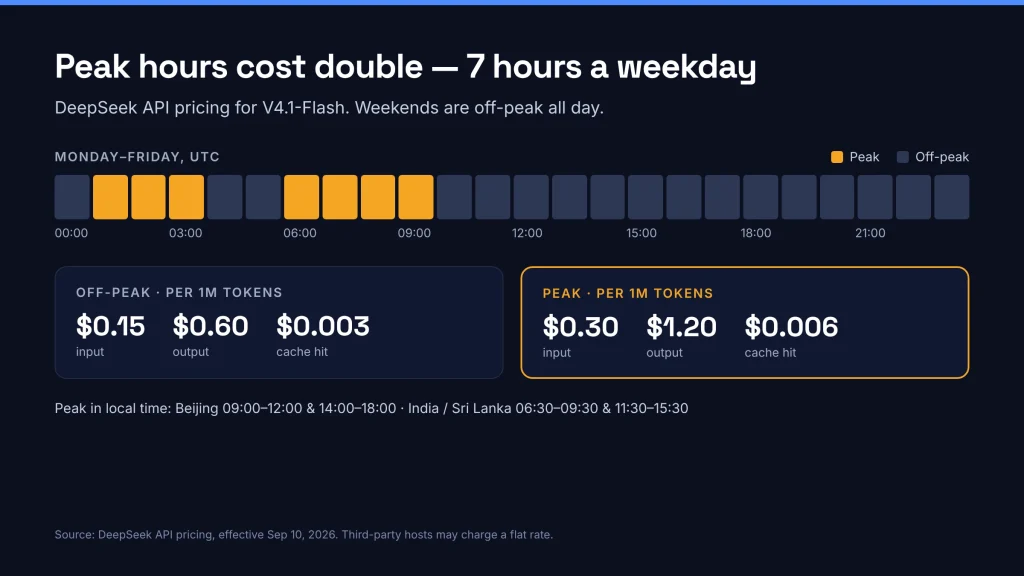
On DeepSeek’s own API, V4.1-Flash costs $0.30 per million input tokens and $1.20 per million output tokens at peak, half that off-peak, with cache hits from $0.003. These rates took effect at 04:00 UTC on September 10, 2026 (Ollama, Apidog).
| Per 1M tokens | Off-peak | Peak |
|---|---|---|
| Input, cache hit | $0.003 | $0.006 |
| Input, cache miss | $0.15 | $0.30 |
| Output | $0.60 | $1.20 |
When is peak? 01:00–04:00 and 06:00–10:00 UTC, Monday to Friday. That is 9:00–12:00 and 14:00–18:00 Beijing time. Every other hour, including all weekend, is off-peak. Peak covers only 35 of the week’s 168 hours, about 21%.
Compared with V4-Flash’s off-peak prices the day before launch, cache hits fell about 57%, cache misses about 32% and output about 9% (RuntimeWire). For anyone who was on V4-Pro, the saving is far larger, because those calls now bill at Flash rates.
What a real agent session costs
Take a typical coding-agent session: 4M input tokens with a 97% cache-hit rate, plus 50K output tokens.
| Line item | Tokens | Off-peak cost | Peak cost |
|---|---|---|---|
| Cached input | 3.88M | $0.012 | $0.023 |
| Uncached input | 0.12M | $0.018 | $0.036 |
| Output | 0.05M | $0.030 | $0.060 |
| Total | ≈ $0.06 | ≈ $0.12 |
Notice where the money goes: output is half the bill even though it is about 1% of the tokens. If you can schedule batch jobs, running them off-peak simply halves the cost.
Third-party providers
V4.1-Flash is open-weight, so dozens of hosts serve it. Prices vary a lot (OpenRouter, Venice).
| Provider | Input / 1M | Output / 1M | Cached / 1M | Note |
|---|---|---|---|---|
| OpenRouter (cheapest listed, Relace) | $0.006 | $0.50 | $0.005 | Lowest headline price; check limits |
| OpenRouter (batch) | $0.112 | $0.336 | — | For non-urgent jobs |
| Fireworks, Together, Baseten, Parasail and others | $0.30 | $1.20 | $0.006–$0.03 | Flat rate, no peak hours |
| Venice | $0.30 | $1.20 | $0.01 | Zero-retention privacy |
| Ollama Cloud | $0.30 / $0.15 | $1.20 / $0.60 | $0.006 / $0.003 | Mirrors DeepSeek peak/off-peak |
Rule of thumb: if you work mostly in Asian business hours, a flat-rate host costs the same as DeepSeek’s peak price. If you work in the evening or weekends anywhere, DeepSeek’s own API off-peak is hard to beat.
How to use DeepSeek-V4.1-Flash
The fastest route is DeepSeek’s own API with the model name deepseek-flash; it is OpenAI- and Anthropic-compatible, so most existing code works by changing two lines (DeepSeek API docs).
Option 1: DeepSeek API (official)
- Create an API key on the DeepSeek Platform.
- Set the base URL to
https://api.deepseek.com(orhttps://api.deepseek.com/anthropicfor Anthropic-style clients). - Use
deepseek-flashas the model. It currently serves V4.1-Flash-1017.
from openai import OpenAI

client = OpenAI(api_key="YOUR_DEEPSEEK_API_KEY", base_url="https://api.deepseek.com")

resp = client.chat.completions.create(
    model="deepseek-flash",
    messages=[{"role": "user", "content": "Explain KV caching in two sentences."}],
    extra_body={"thinking": {"type": "enabled"}, "reasoning_effort": "high"},
)
print(resp.choices[0].message.content)
Old model names deepseek-v4-flash and deepseek-v4-flash-vision-exp still work, but they are routed to the new model and billed at Flash prices.
Option 2: Inside coding agents
DeepSeek officially documents setups for Claude Code, Codex, OpenCode, OpenClaw, Hermes, WorkBuddy/CodeBuddy and its own DeepSeek Harness. With Ollama’s cloud model, launching Claude Code on V4.1-Flash is one line:
ollama launch claude --model deepseek-v4.1-flash:cloudOption 3: OpenRouter and other aggregators
Use the slug deepseek/deepseek-v4.1-flash on OpenRouter. OpenRouter routes across 30+ providers and falls back automatically when one fails. Venice uses deepseek-v4-1-flash-1017 if you want zero data retention.
Option 4: Ollama
ollama run deepseek-v4.1-flash:cloud
# or the October update:
ollama run deepseek-v4.1-flash:1017-cloud
Note that both Ollama tags are cloud models. There is no small local version you can run on a laptop.
Option 5: Self-host the open weights
The weights are MIT-licensed, so you can run them on your own hardware with vLLM or SGLang:
pip install vllm
vllm serve "deepseek-ai/DeepSeek-V4.1-Flash-1017"
Be realistic about hardware. The FP8 checkpoint is roughly 763B parameters, which means a multi-GPU data-centre server, not a gaming PC. The model card also ships no Jinja chat template: use the encoding.py reference or the deepseek-recipe library to format prompts.
Recommended settings: temperature 1.0, top_p 0.95–1.0 (1.0 for 1017), a 1M-token context window and max_tokens of at least 256K for long agent runs. Open-weight deployments expose reasoning effort as a number from 1 to 100.
Best use cases — and honest limitations
V4.1-Flash is at its best when a task means reading a lot, thinking moderately and writing a little, many times in a row. That describes most agent work.
Where it shines
- Coding agents on real repositories. Top-tier DeepSWE and Terminal-Bench 2.1 scores, plus cheap cached context for re-reading a codebase every step.
- Terminal and computer-use automation. Its AutomationBench and Agent’s Last Exam results beat every model DeepSeek compared against.
- Long-document analysis. Load hundreds of pages, contracts or logs into the 1M-token window and query them repeatedly.
- Multimodal workflows. Screenshots, charts, scanned documents and UI mock-ups as input, with a DocVQA score of 95.6 on the base model.
- Security research and CTF-style work. 88.1 on CyberGym is the highest in its comparison table.
- High-volume production at low cost. When spend per request, not peak intelligence, is the hard limit.
Where to be careful
- Very long, multi-hour terminal jobs. Even after 1017, Opus 5 still leads Terminal-Bench 4.0 (51.8 vs 42.3).
- Pure knowledge without tools. HLE without tools is well behind Opus 5. Give it search tools whenever you can.
- Token-hungry thinking. At max effort it produces a lot of reasoning tokens, and output is the expensive part of your bill. Lower the reasoning effort for simple tasks.
- Peak-hour surprises. Weekday jobs in Asian business hours cost double on DeepSeek’s API.
- Self-hosting is heavy. Open weights don’t mean small; plan for data-centre GPUs.
- Data residency. DeepSeek is a China-based company, and OpenRouter notes the model isn’t available through its EU in-region routing. If that matters, choose a host whose location and retention policy suit you.
- Text-only output. It understands images but cannot generate them.
DeepSeek V4.1 Flash vs the alternatives
For price-per-capability on agent work, nothing in the current open-model market matches V4.1-Flash; you pay more only when you need peak reasoning or a closed model’s extra polish. Prices below are list prices per 1M tokens (Venice, Artificial Analysis).
| Model | Open weights | Context | Input / Output price | Pick it when |
|---|---|---|---|---|
| DeepSeek V4.1-Flash-1017 | Yes (MIT) | 1M | $0.30 / $1.20 (half off-peak) | You want frontier-level agentic coding at budget prices |
| DeepSeek V4-Pro | Yes (MIT) | 1M | Now routed to V4.1-Flash | Not anymore — it is being phased out |
| Kimi K3 | Yes | 1M | $3.75 / $18.75 (Venice) | Peak open-weight reasoning matters more than cost |
| GLM-5.3 | Yes | — | Varies by host | You already run Zhipu models; slightly behind on agent benchmarks |
| Qwen 3.7 Plus | No | 1M | $0.50 / $2.00 (Venice) | Balanced general chat |
| Gemini 3.5 Flash-Lite | No | — | $0.30 / $2.50 | Short, simple tasks where fewer thinking tokens keep cost per task low |
| Claude Opus 5 / GPT-5.6 Sol | No | — | Much higher | Hardest long-horizon tasks and knowledge-heavy reasoning |
Two honest counterpoints. First, Artificial Analysis found Gemini 3.5 Flash-Lite cheaper per task ($0.12 vs $0.27) despite a higher output price, because it thinks far less, though it also scored 23 vs 40 on intelligence. Second, Venice notes that newer small models from OpenAI and Anthropic matched V4.1-Flash on one data-analytics benchmark at lower cost and latency. Cheapest per token is not always cheapest per finished job.
Frequently asked questions
What is DeepSeek-V4.1-Flash?
It is DeepSeek’s 552B-parameter multimodal Mixture-of-Experts model, released September 10, 2026. It uses a Causal Encoder–Decoder design that activates 8B parameters to read and 16B to write, supports a 1M-token context and accepts images as well as text.
What is DeepSeek-V4.1-Flash-1017?
It is the October 17, 2026 update of V4.1-Flash. The architecture is the same, but benchmark scores are higher across the board, tasks finish faster and outputs are shorter. It now serves the deepseek-flash API model name.
Is DeepSeek V4.1 Flash open source?
Yes. Both V4.1-Flash and V4.1-Flash-1017 weights are on Hugging Face under the MIT license, which allows commercial use.
How much does DeepSeek V4.1 Flash cost?
On DeepSeek’s API: $0.30 input and $1.20 output per million tokens at peak, $0.15 and $0.60 off-peak, and $0.003–$0.006 for cache hits. Third-party hosts typically charge a flat $0.30 / $1.20.
What are DeepSeek’s peak hours?
01:00–04:00 and 06:00–10:00 UTC, Monday to Friday. All other times, including weekends, are billed at half price.
Is V4.1-Flash better than DeepSeek V4-Pro?
On DeepSeek’s and independent tests, yes. It scores higher on agentic benchmarks, runs about three times faster and costs much less. DeepSeek now routes all V4-Pro API traffic to it until V4.1-Pro launches.
Does DeepSeek V4.1 Flash support images?
Yes. Vision is native, trained jointly with text from the start. It accepts images as input but only produces text.
What is the context length of DeepSeek V4.1 Flash?
1 million tokens. Maximum output depends on the host, from 128K on Venice up to 384K on DeepSeek’s API.
Can I run DeepSeek-V4.1-Flash locally?
Technically yes, with vLLM, SGLang or community quantizations, but the full model needs a multi-GPU server. Ollama’s tags are cloud-hosted, not local downloads.
Is DeepSeek V4.1 Flash good for coding?
It is one of the strongest coding-agent models available at any price. The 1017 version scores 77.0 on DeepSWE v1.1, ahead of both Opus 5 and GPT-5.6 Sol, though Opus 5 still leads on the longest terminal tasks.
When will DeepSeek V4.1-Pro be released?
DeepSeek has not given a date. It has only said that V4-Pro requests will route to V4.1-Flash until V4.1-Pro launches.
Final verdict: should you switch to DeepSeek V4.1 Flash?
If you run coding or automation agents and pay your own API bills, yes — DeepSeek-V4.1-Flash-1017 is the default choice to beat right now. It matches or beats frontier closed models on most agent benchmarks, and a typical multi-million-token session costs around five cents.
The smarter question is how to use it well:
- Lean on the cache. Keep system prompts and tool definitions identical across calls so repeated input bills at $0.003–$0.006.
- Schedule around peak hours. Anything that can wait should run outside 01:00–10:00 UTC on weekdays.
- Tune reasoning effort. Max effort is for hard problems; most tasks don’t need 89K thinking tokens.
- Keep a frontier model on call. For the longest terminal jobs or knowledge-heavy questions without tools, Opus 5 or GPT-5.6 Sol still earn their price.
The bigger takeaway is architectural. DeepSeek didn’t win by building a bigger model; it won by reading cheaply. If V4.1-Pro applies the same ideas at a larger scale, the price of frontier-grade agents is going to keep falling.